From the category archives:

relationships

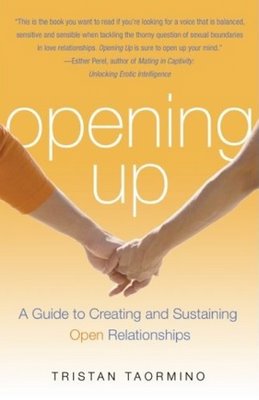
openingup Opening Up: A Guide to Creating and Sustaining Open Relationships

Opening Up: A Guide to Creating and Sustaining Open Relationships” by Tristan Taormino is an enlightening and thought-provoking book that explores the diverse aspects of nonmonogamous relationships from solo polyamory, to partnered nonmonogamy, to triangles and groups.  The book features a wealth of information from stats to brief histories of polyamory in the U.S., as well as Taormino’s own research on the subject where she interviewed over 100 people living in open relationships over the past ten years.

The Guide begins by relating the history of polyamory, as well as breaking the myths of monogamy and traditional relationships, why you might want to choose a nonmonogamous lifestyle and what makes nonmonogamy work.  Section 2 looks at the many styles or models of nonmonogamous relationships and Section 3 talks about creating and sustaining relationships.  There is also a resource guide at the end which lists books, organizations and websites for further information.

Throughout the book Taormino uses checklists and practical advice for the reader which she says can be used like a roadmap to navigate your own way through the different styles and create your own model based on you and your partner(s) needs, desires, and unique situation(s).  Like any emotional or sexual relationship, polyamorous relationships have unique problems, potential issues and conflicts that arise that are common to open relationships.  Taormino deals with each of these giving practical advice and coping strategies including: jealousy, fear of abandonment, time management, negotiating boundaries, violating agreements, new desire, coping with change, safer sex as well as legal issues.

The highlight of the book is the real life experiences Taormino uses with quotes, stories and advice from a diverse group of people who share their desires, fears, challenges, solutions, successes and failures with the reader to provide meaningful context.  This book is really a thoughtful and comprehensive guide on open relationships of all kinds, leaving no stone unturned.  Enlightening, inspirational, and practical, this book is for anyone interested in or already living in responsible nonmonogamous relationships.

You can purchase “Opening Up: A Guide to Creating and Sustaining Open Relationships” by Tristan Taormino at Babeland.



 Opening Up: A Guide to Creating and Sustaining Open Relationships

 Opening Up: A Guide to Creating and Sustaining Open Relationships

{ Comments on this entry are closed }

Cancel, unsubscribe, unfollow. Sort out how you want to react to the breakup only after you’ve canceled the relationship, unsubscribed from her Tumblr, or blocked him from Twitter. To undo a relationship that made it online in any form—whether you’ve got photos together all over MySpace or earned your own tag on Gawker—requires investing as much shared exposure as you put in. Make a cold calculation: in my case, that meant reframing a year-and-a-half long affair, across half a dozen online networks, and doing it in just a few days. This condenses everything: how much it hurts, how fast you have to react. You had weeks or months to attach to one another’s blogs, profiles, and endearingly staged snapshots. Now you have to delete or address it all, all at once.

Link

{ Comments on this entry are closed }

My friend and fellow blogger Mimi’s most recent post ‘Legacies from the Men in my Life’ got me thinking, not in a general sense but in a sexual one. Funny that. In truth, the men in my life have probably taught me more about sex than about anything else. I’ve always been a self-contained, opinionated woman with a wide variety of interests so it’s hard to separate what I actually learned by myself from what I was taught by the men in my life. Actually, that’s not totally true. My ex-husband taught me a hell of a lot about music. And the one after that, the alcoholic, taught me I’m a very bad drinker. Whereas the one after that taught me how to make a very nice martini using apple and orange juice. He also taught me that when a man tells you ‘I’m a one woman man,’ he very rarely means it. The same man told me that I’d look much better with short, curly hair and he was right.

Then there’s the Sexual Legacies. In no particular order:

Ex-husband – I was young. I was relatively inexperienced (but thought I knew it all) So was he. When we got divorced, I was none the wiser.

Link

{ Comments on this entry are closed }

And I don’t mean money. I mean culture, understood in the widest sense.

Whatever about the men, intimacy with them put me in touch with a wide variety of microcultures.

I wonder what legacies, if any, they have from me.

* * *

from my first husband

Agatha Christie, Dorothy Sayers, Mozart opera; some sense of how a genius thinks (he was — still is, I suppose — a genius); an understanding of what it was like to grow up Catholic in the U.S. in the 1950s; some sense of what ‘Canadian’ means; a visionary notion of political activism

(he was passionate about Native American education; against the then corrupt miltary regime in Chile; against capital punishment, etc.)

Link

{ Comments on this entry are closed }

Science Daily — Contrary to popular opinion, feminism and romance are not incompatible and feminism may actually improvethe quality of heterosexual relationships, according to Laurie Rudman and Julie Phelan, from Rutgers University in the US. Their study* also shows that unflattering feminist stereotypes, that tend to stigmatize feminists as unattractive and sexually unappealing, are unsupported.

It is generally perceived that feminism and romance are in direct conflict. Rudman and Phelan’s work challenges this perception. They carried out both a laboratory survey of 242 American undergraduates and an online survey including 289 older adults, more likely to have had longer relationships and greater life experience. They looked at men’s and women’s perception of their own feminism and its link to relationship health, measured by a combination of overall relationship quality, agreement about gender equality, relationship stability and sexual satisfaction.

(more . . .)

{ Comments on this entry are closed }

Alexandra Rankin Macgill writes:

Everyone has a friend or two who takes that much longer to respond to emails because they just don’t ever check their accounts, who don’t want to join social networks and who never pop up on IM and gTalk. What happens when you fall in love with someone like that?

A friend in a serious relationship has declared herself as “single” on Facebook, the social networking site, not because she isn’t madly in love with her boyfriend, but because her boyfriend won’t create a Facebook profile. As a compulsive Facebook user (she updates her picture weekly and has at least 5 new posts on her wall every day), many of her social and family ties are maintained through communications via Facebook. In not joining Facebook, her boyfriend misses a part of life that is important to her.

(more . . .)

{ Comments on this entry are closed }

How does Suzanne Craig, wife of the outed Senator, stand next to her disgraced Potty Liar of a husband at a press conference, and not hurl her guts?
She’s not the first political wife to put on a show. The spectacle of a prominent woman standing by her man, now revealed to be an adulterer— and of a bent that she could never satisfy— is one of bewildering aspects of the recent Prig-Freak scandals.

Some say there’s one explanation for the wifely stoicism: “She’s protecting her investment.”

Certainly, with the money and prestige involved in a  “First Lady”-type of profession, this makes practical sense. Maybe if the reporters called Mrs. Craig after the divorce settlement is signed, and her social future is assured, they’d get an earful that would make their drums bleed.

However, there’s a part to the cuckquean’s inevitable reaction that is completely denied, because of our cultural inability to imagine a woman’s sexual outrage. We don’t even commonly use this word for a female cuckold, which is remarkable considering the extent of the experience. It’s not just GOP Christian SAHM’s who are going through this. (more. . .)

{ Comments on this entry are closed }

by Regina Lynn

The internet has become a proving ground for trying out relationship styles, and anyone who’s ever done so knows just how serious online relating can become — even if all you intended was a quick look to see what all the fuss was about.

These relationships can and do become the catalyst for drastic and painful transitions in your life. They can help you “get it out of your system” and confirm your relationship choices, or they can open your eyes to Your True Path. Whether your partner wants to walk that road with you is a whole ‘nother thing.

Given the impulse to interact and connect with other humans once we’re online, you might think that a virtual relationship — a relationship with a fictional partner — would be an even better way to learn about how we relate to one another, without risk of heartbreak or life-changing decisions.

That’s one of the questions behind a recent University of Illinois study that took three groups of subjects through three variations of a virtual relationship to see how attachment styles — how secure or insecure one is about intimacy — correspond to actions in a relationship. (more. . . )

{ Comments on this entry are closed }

Melinda Wenner
Special to LiveScience
LiveScience.com Tue May 29, 10:41 AM ET

People who are socially dominant and either very friendly or very antagonistic tend to be more sexually promiscuous, according to a new study.

Friendly, warm people may enjoy sharing their warmth with others by sleeping with them, whereas antagonistic people may sleep around to avoid having a monogamous relationship. And having a dominant personality makes it easier to approach potential partners. (more. . .)

{ Comments on this entry are closed }

…In a Stiletto Relationship, what you feel is an addicting mix of love, lust, and pain.

Although you know on some level that “the mix” is toxic – and making you feel crazy – it’s incredibly hard to get that person, and the relationship, out of your system.

Why is that?

One of my favorite theories about what makes these relationships so addicting – other than sexual chemistry – is that the “stiletto lover” we get drawn to taps into a dark, exhilarating part of us.

When that part of us gets liberated, an adrenalin rush comes along with any fear, or sense that we’ve lost control. And that adrenalin rush helps us forget temporarily about the pain that will inevitably follow. It can even trick us into believing that the relationship is getting healthier. (more. . .)

{ Comments on this entry are closed }

0688155901 1 Short story: The Great Passover Rebellion of 1963
With the news I’ve been reading this week about equal pay, and women dropping out of the work force, I offer up this story by writer Candida Korman about the working women who paved the way for us, and who got mad as hell and weren’t going to take it anymore:

“As far as I’m concerned feminism wasn’t about going out of the house to work, it was about getting respect for the work we were already doing. And, if possible, getting the promotions and raises and decision-making opportunities that men had. 1963 was the year that the Feminine Mystique was published.”

“Betty Freidan, right?”

“Yes. It was a very important book. Your mother was the first one to read it. She loaned it to my mother and then to me. We passed it on to other friends. We talked about it all the time. I was tired of the way my father favored your father over me. I was really tired of that. My Fred was dying and I was putting in late hours at work followed by trips to the hospital. I had two small children who kept asking about their father. I don’t think I slept more than five hours a week and when your grandmother sat me and your mother down to discuss the who would cook what for Passover, I exploded.

Candida (named for the G.B. Shaw heroine) is also a 2nd round finalist in Gather.com’s Chapter Writing Contest. Sort of like an ‘American Idol’ for publishing.

(Photo: Recipe Link)

{ Comments on this entry are closed }

What other columnists should I be linking to? Please leave suggestions in the comments. I can’t promise I’ll include them all. I notice the Village Voice has a nice spiffy new site, but when are they going to ask RKB to rejoin them?

And someone (maybe you) needs to update the Wikipedia entry. It’s outdated.

{ Comments on this entry are closed }

By Mike Penner
Times Staff Writer

During my 23 years with The Times’ sports department, I have held a wide variety of roles and titles. Tennis writer. Angels beat reporter. Olympics writer. Essayist. Sports media critic. NFL columnist. Recent keeper of the Morning Briefing flame.

Today I leave for a few weeks’ vacation, and when I return, I will come back in yet another incarnation.

As Christine.

I am a transsexual sportswriter. It has taken more than 40 years, a million tears and hundreds of hours of soul-wrenching therapy for me to work up the courage to type those words. I realize many readers and colleagues and friends will be shocked to read them.

That’s OK. I understand that I am not the only one in transition as I move from Mike to Christine. Everyone who knows me and my work will be transitioning as well. That will take time. And that’s all right. To borrow a piece of well-worn sports parlance, we will take it one day at a time. (more.. . )

[via BoingBoing]

{ Comments on this entry are closed }

Tristan Taormino, award-winning author, columnist, editor and sex educator, is the featured speaker at Barnard’s sex-positive event “Sexhibition.”

The Path to Sexual Empowerment
Sulzberger Parlor – Barnard campus
Tonight, Wed, April 25 – 8pm
FREE
What is sexual empowerment? What does it mean to be sexually empowered? Tristan reveals the pleasures and pitfalls of her journey from law school reject to sex expert—with stops along the way as editor, author, anal sex guru, Village Voice columnist, sex-positive event roducer, and feminist pornographer. She’ll explore the concept of erotic power, discuss why it is important, and share her unique recipe for how everyone can become sexually empowered.

DIRECTIONS:
Sulzberger Parlor is in Barnard Hall on Barnard’s Campus. Take the 1 to 116th Street/Columbia University (the 2 and 3 will not take to you the campus even though there is a 116th stop). Once you get out of the subway, Barnard is on the north west corner, but the entrance gates are on 117th and Broadway. Barnard Hall is the building directly in front of you once you enter the gates (“Barnard” is engraved on it). Enter Barnard Hall and take the elevators/stairs on the left to the third floor. Sulzberger Parlor is through the doors on the left (there will be a sign).


{ Comments on this entry are closed }

lede 23 sex New York Magazine: The Sex & Love issue

{ Comments on this entry are closed }